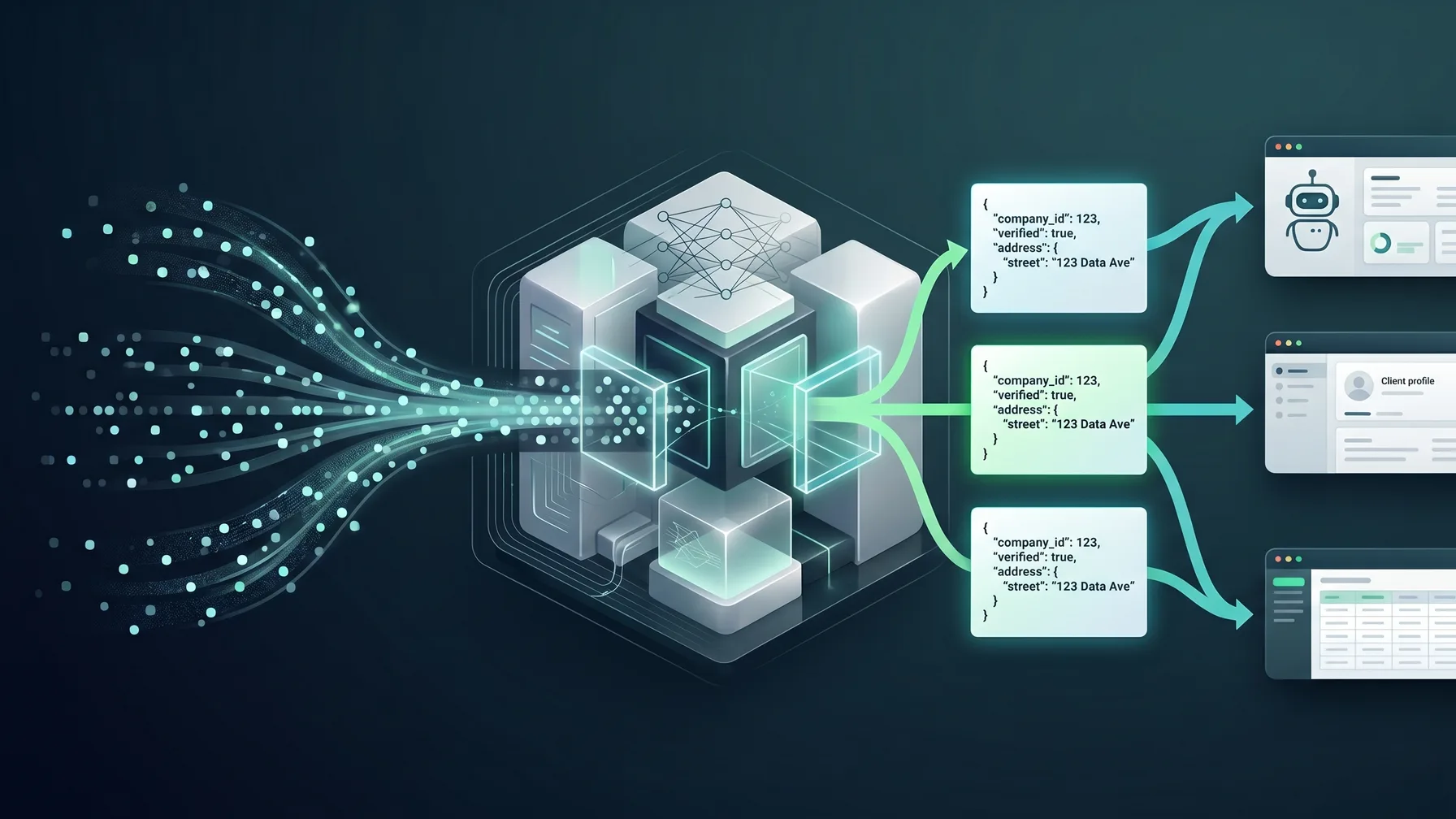
A startup data API is a programmatic interface that returns structured information about startups - typically company profiles, funding rounds, investors, headcount signals, and founder details - as JSON your software can consume. Teams use them for investment sourcing, sales intelligence, and market mapping. If your actual question is "which new businesses exist in this market and how do I contact them," you may need a local business data API instead: a related but different category that returns operating businesses by location and keyword, with websites, phones, and emails.
What a Startup Data API Returns
The category is defined by its fields. A typical startup data API exposes some mix of:
- Company profile: name, domain, description, industry tags, founding year, HQ location.
- Funding data: rounds, amounts, dates, stage (seed, Series A+), and participating investors.
- People: founders and executives, sometimes with role history.
- Growth signals: headcount ranges and changes, job openings, web traffic estimates.
- Identifiers: stable company IDs so you can sync records over time.
Delivery is usually a REST API returning JSON, sometimes with bulk exports (CSV) or webhooks for new events such as "company X raised a round." Providers in this space include startup databases and market-intelligence platforms; pricing is typically subscription-based and tiered by API volume and field access.
Who Actually Needs One
Startup data APIs earn their cost in three workflows:
- Investment sourcing and diligence. VCs and corporate development teams track who raised, at what stage, in which sector - and want the deal flow in their own CRM rather than a vendor UI.
- Sales intelligence on funding triggers. "Companies that raised in the last 90 days" is a classic outbound trigger: fresh budget, hiring plans, new tooling needs.
- Market and competitor mapping. Analysts assembling a landscape (every fintech startup in Europe with 11-50 employees) need firmographics at query scale.
If your workflow matches one of those, evaluate providers on coverage (geographies, private-company depth), freshness (how quickly new rounds appear), field licensing (can you store the data?), and API ergonomics (stable schemas, sane pagination, webhooks).
Startup Data API vs Business Data API
Here is where teams often discover they searched for the wrong category. The two overlap on firmographics but answer different questions:
| Dimension | Startup data API | Local business data API (e.g. biz collect) |
|---|---|---|
| Core question | Who raised, who invested, how fast is it growing? | Which businesses operate in this location and category, and how do I contact them? |
| Typical record | Funded tech company with round history | Operating local business: dentist, agency, contractor, restaurant, SaaS office |
| Discovery input | Filters: sector, stage, geography, headcount | location, keywords, radius_km |
| Contact data | Founder/executive names, sometimes emails via enrichment partners | Website, phone, and deduped emails extracted from the business's own site |
| Best for | VCs, corp dev, funding-trigger outbound | Lead generation, CRM enrichment, AI agents, market mapping by geography |
Most local businesses never raise venture funding, so they are invisible to funding-centric databases. The reverse is also true: a local business data API will not tell you who led a Series B. Some teams need both layers; many discover they only need one.
If your list should be "every physiotherapy practice within 20 km of Munich, with emails," that is a geography-and-category job. biz collect handles it as one POST request: it discovers businesses via official Google Places search, enriches each from its own website, and returns 20+ structured JSON fields per record - a deliberately different sourcing model from scraping, as explained in the Google Places API vs scrapers vs business data APIs comparison. For how to evaluate this category in depth (fields, freshness, cost), see the business data API guide.
How to Evaluate Any Company-Data API
Whichever category you land in, the same buyer checklist applies:
- Field contract: Is the schema documented (OpenAPI), stable, and versioned? Agents and integrations break on schema drift.
- Sourcing and licensing: Where does the data come from, and are you allowed to store it? (For Google-sourced data specifically, see what the Google Places API terms allow you to scrape and store - the caching rules surprise most teams.)
- Freshness: How old is a record when you receive it, and how is it refreshed?
- Coverage honesty: Every vendor claims global coverage; test your actual geographies and segments before paying.
- Cost model: Per-call, per-record, or credit-based? Model your real workflow, not the demo.
- Automation fit: Async jobs, webhooks, and idempotency matter once the API sits inside n8n, Make, Zapier, or an AI agent loop. The AI lead generation agent guide shows what agent-ready looks like in practice.
The Bottom Line
A startup data API gives you the funding-and-firmographics layer: who raised, who invested, how companies are growing. A business data API gives you the operating-reality layer: who is actually doing business in a place, with contact paths attached. Name the question first, then pick the API - and hold either one to the same standard: documented schema, honest sourcing, storable data, and a price you can model.
Frequently asked questions
- What is a startup data API?
- A startup data API is a programmatic interface that returns structured data about startups - company profiles, funding rounds, investors, founders, and growth signals such as headcount - as JSON. Teams use them for investment sourcing, funding-trigger sales outreach, and market mapping.
- What data does a startup data API include?
- Typically company profiles (name, domain, industry, HQ), funding history (rounds, amounts, investors), people data (founders, executives), and growth signals (headcount changes, job openings). Exact fields, coverage, and storage rights vary by provider, so check the schema and license.
- How is a startup data API different from a business data API?
- A startup data API centers on funding and firmographics for (mostly venture-backed) companies. A business data API like biz collect returns operating businesses discovered by location and keyword, with websites, phones, and deduped emails - most local businesses never appear in funding databases.
- Can a startup data API give me contact emails?
- Sometimes, usually for founders and executives via enrichment partnerships, with varying accuracy. For operating local businesses, emails are more reliably extracted from each business's own website - which is the enrichment step biz collect performs when scrape_emails is enabled.
- Is there a free way to test a company-data API?
- Most startup-data vendors offer trials or limited free tiers. biz collect's free tier is 200 signup credits plus 20 more per day you log in, with no credit card, which is enough to test real cities and keywords before committing.