Who it's for
- Teams building LLM-powered SDR or research agents (Claude, ChatGPT, Codex).
- Founders wiring an agent into outbound without a data engineering team.
- Anyone who wants one stable tool instead of a stack of brittle scrapers.
Give your LLM agent one tool that turns a request into callable leads.
The problem
An AI SDR or research agent is only as good as the data it can reach. Ask it to 'call accounting firms in Austin' and it has to find the firms, locate phone numbers, dig usable emails out of websites, and normalize everything into fields it can act on. Wired up by hand, that is several brittle tools, a lot of glue code, and a high rate of hallucinated or malformed records.
biz collect collapses that into a single tool the agent can call. Because the request shape is small and the response schema is stable, the agent fills a few low-ambiguity parameters and gets predictable JSON back - no guessing field names, no parsing a different layout per source.
The workflow
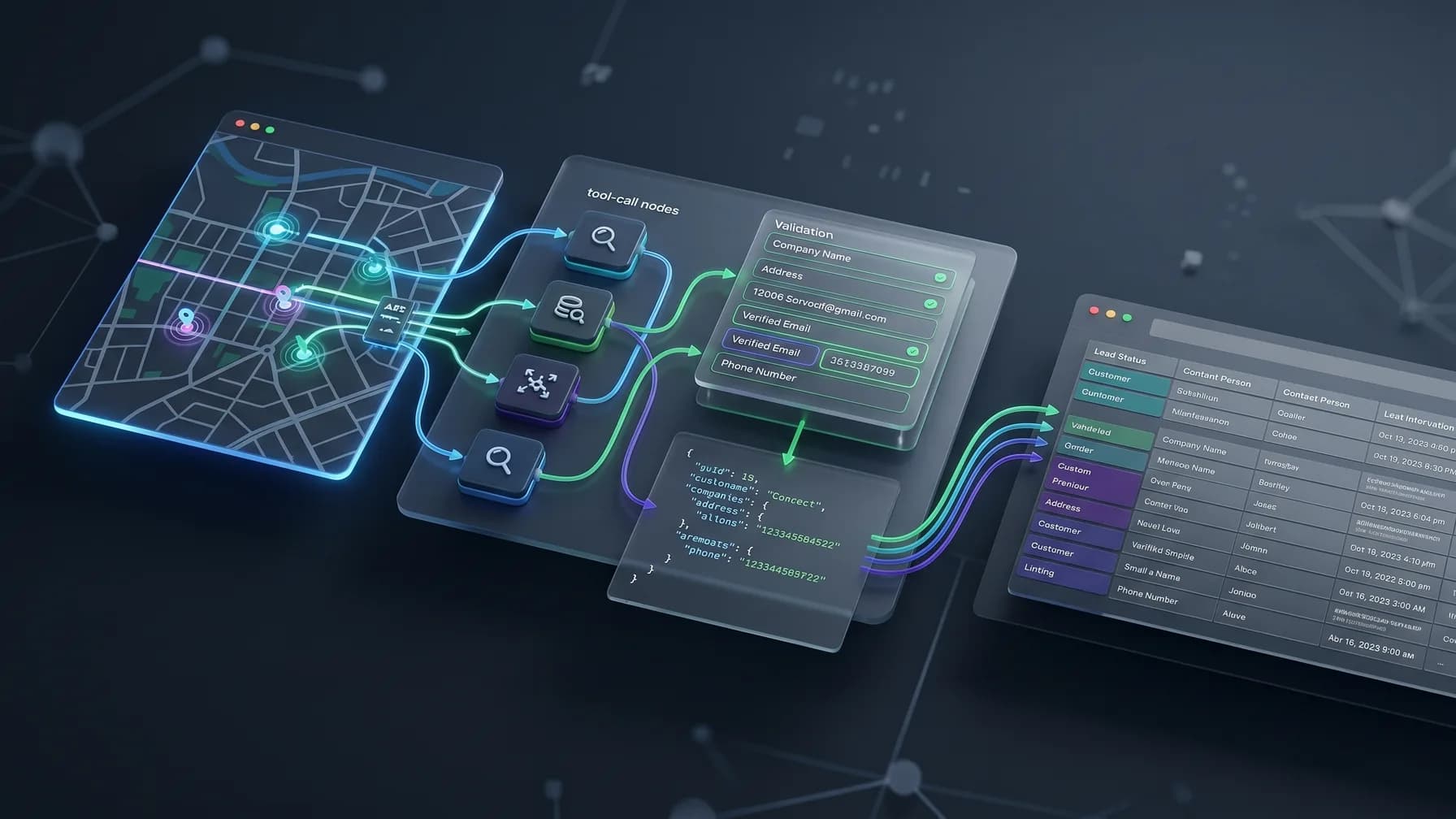
Point your agent's tool config at the OpenAPI 3.1 spec and add your bearer token. Claude, ChatGPT, and Codex-style agents can register it directly, so the two endpoints become callable tools with typed parameters.
When the user asks for, say, accounting firms in Austin within 10 km, the agent fills location, keywords, and radius and POSTs to /v1/search. It receives a job_id immediately.
The agent polls GET /v1/jobs/:id until the job is done. Polling is free, so waiting on the async job adds no credit cost and the agent loop stays simple.
The completed job returns business records with name, category, address, phone, website, deduped website emails, social profiles, ratings, and hours - already normalized into stable fields.
The agent filters by open/closed status, ranks by rating, drafts outreach using the contact data, or hands the records to the next tool (a dialer, a CRM writer, an email step) - all inside one tool loop.
Fields & endpoints
POST /v1/searchThe single entry point: location, keywords, and radius map cleanly to a user request.
GET /v1/jobs/:idFree polling means the agent can wait on async jobs without burning credits.
email(s)Deduped emails extracted from each business website - the field that makes a lead actionable.
phone, website, social profilesMultiple contact channels so the agent can choose how to reach out.
live open/closed status, ratingsLets the agent prioritize reachable, well-rated businesses first.
Example
Suppose an SDR agent is told to build a call list of independent accounting firms within 10 km of downtown Austin. It calls biz collect once with that location, the keyword 'accounting firm', and a 10 km radius, then polls until the job finishes.
It receives a normalized list of firms with phone numbers, websites, and deduped emails pulled from those websites. The agent drops anything currently marked closed, sorts by rating, and starts drafting personalized first-touch emails from the contact data - without a human assembling the list first. This is an illustrative workflow, not a guaranteed result; coverage depends on what is publicly available for each business.
Everything you need to ship this workflow:
AI sales-agent enrichment
Register the OpenAPI 3.1 spec as a tool and add your bearer token. The agent then calls POST /v1/search with location, keywords, and radius, polls GET /v1/jobs/:id until the job completes, and reads structured business records back.
LLM tools work best with low-ambiguity inputs and predictable outputs. Because biz collect always returns the same fields, the agent does not have to guess field names or parse a different layout per source, which reduces malformed or hallucinated records.
No. Polling GET /v1/jobs/:id is free, so an agent can wait on an async job without adding credit cost. Searches spend credits based on result pages and unique keyword queries.
Where available, each record includes name, category, address, phone, website, deduped emails from the website, social profiles, ratings, reviews, opening hours, and live open/closed status - over 20 fields in total.
Yes. The free tier includes 200 signup credits plus 20 daily login credits with no credit card, which is enough to wire an agent to a real search and see the response shape end to end.
Still have questions? Talk to us.
Related guides to take your business-data workflow further.
Sign up free with 200 signup credits, no credit card. POST a search, poll the job, and wire the structured JSON straight into your stack.