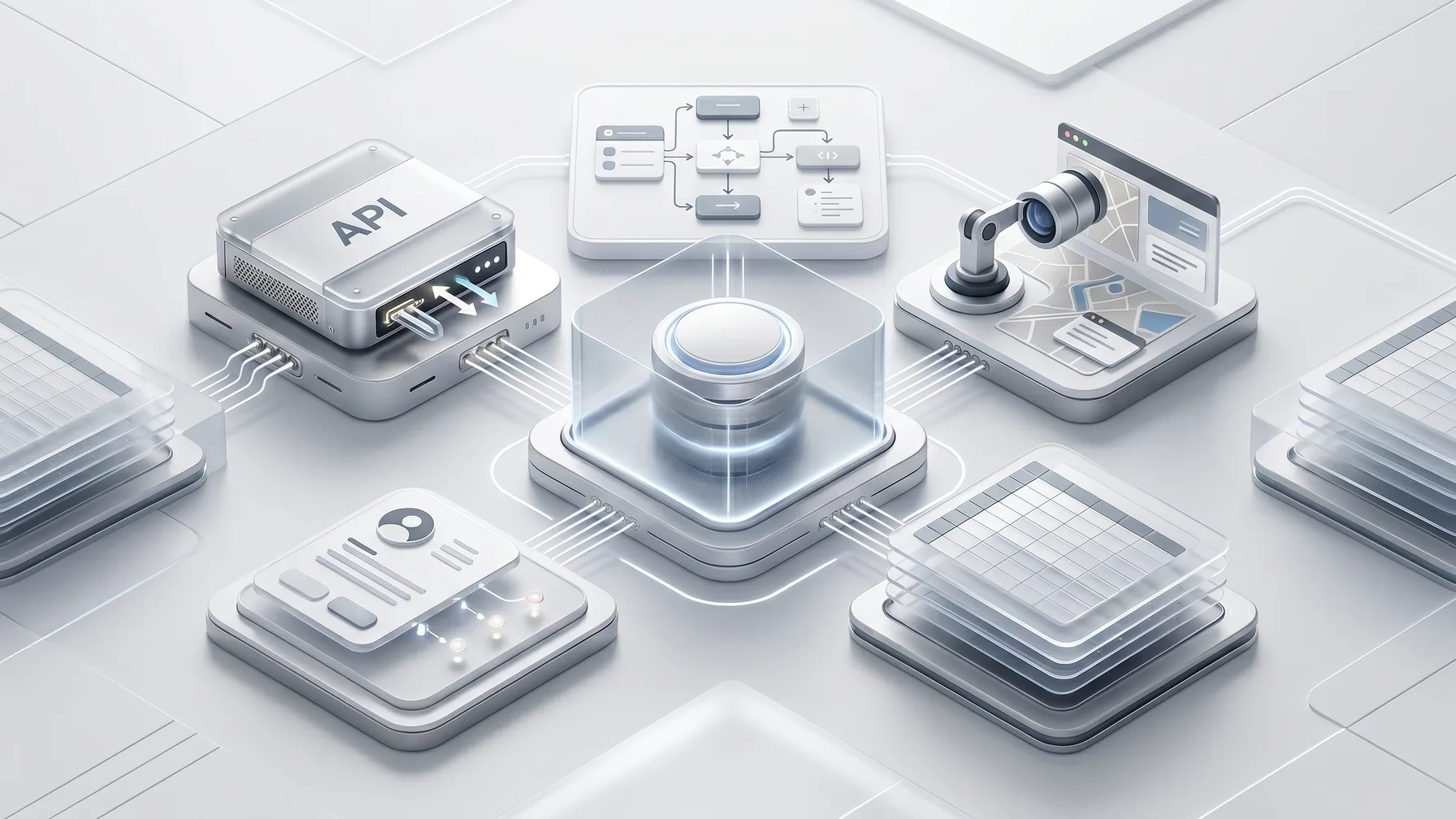
B2B prospecting tools fall into four honest categories: data APIs (fresh, structured records by query), scrapers (raw extraction you maintain), directories and databases (prebuilt contact data), and all-in-one sales platforms (data plus outreach in one UI). None is "best" universally - each fits a different job, budget, and level of control. This guide maps which is which.
Search "best B2B prospecting tool" and you get listicles that rank apples against oranges - a scraper next to a sales suite next to an email finder, as if they solve the same problem. They don't. This guide compares the four real categories honestly, names representative tools in each (verified against their own positioning, not invented claims), and tells you which category fits which situation.
The Four Categories
| Category | What it is | You get | You give up | Representative tools |
|---|---|---|---|---|
| Data API | Query-driven structured records | Fresh, scoped JSON on demand | A bit of setup (a request body) | biz collect, and other business/company data APIs |
| Scraper / scraping platform | Run extractors against sites | Raw data, maximum flexibility | Maintenance, terms risk, cleanup | Apify (hosted scraper actors) |
| Directory / database | Prebuilt contact datasets | Volume immediately | Freshness, shared/generic contacts | Large B2B databases and list vendors |
| All-in-one sales platform | Data + enrichment + outreach in one UI | A complete workflow | Flexibility, price, lock-in | Apollo.io, ZoomInfo |
| Point tool (email finder) | Find/verify emails for known domains | Deliverable addresses | Discovery breadth | Hunter.io |
| Enrichment orchestration | Combine many data sources | Coverage via "waterfall" | It is a layer, not a source | Clay |
The rows blur at the edges (some platforms include an API; some scrapers offer datasets), but the center of gravity of each tool sits in one category, and that is what you should buy for.
Category 1: Data APIs
A business data API turns a query - a location, keywords, a radius - into fresh, structured records. You POST a request and get JSON back that your script, spreadsheet, CRM, or AI agent can consume directly.
- Strengths: freshness (discovered per query, not a stale snapshot), tight scoping (the query is your ICP), and automation-readiness (stable schema, no HTML to parse).
- Trade-offs: you write a request instead of clicking a UI, and you build the outreach layer yourself (or bolt on another tool).
- Best for: teams building a repeatable pipeline, developers, and AI-agent builders who want data as a clean contract.
biz collect sits here: one POST /api/v1/search returns operating businesses by location and keyword, enriched from each site with deduped, confidence-scored emails and named contacts. It is the finding layer, not a sending suite - which is the point. See how to find businesses to contact for where it fits against manual and directory methods, and the flagship comparison for API vs scraper specifically.
Category 2: Scrapers and Scraping Platforms
Scraping platforms like Apify let you run extractor "actors" against websites and map results, including Google Maps scrapers. They are the most flexible option and can reach data no structured API exposes.
- Strengths: flexibility - if it is on a page, a scraper can, in principle, get it.
- Trade-offs: you own the maintenance (selectors break, anti-bot defenses change), you inherit terms-of-service risk, and the output usually needs cleanup and dedupe before it is usable. Note that Google's own Places API returns no email field - confirmed in Google's documentation - so scrapers reach emails by visiting each business's website, the same underlying step a data API automates.
- Best for: engineering teams that need bespoke extraction and are willing to maintain it.
Our Google Places scraper guide and the Apify vs Clay comparison go deeper on this category.
Category 3: Directories and Databases
Large B2B databases and directory vendors sell prebuilt contact datasets - you filter by segment and export.
- Strengths: immediate volume, no research time.
- Trade-offs: freshness (a database is a snapshot that decays as businesses change) and shared contacts (the same generic addresses are sold to many buyers, which depresses reply rates).
- Best for: broad, high-volume targeting where tight scoping and freshness matter less.
Category 4: All-in-One Sales Platforms
Platforms like Apollo.io and ZoomInfo bundle a contact database, enrichment, and outreach sequencing into one interface. Per their own positioning, Apollo is an affordable all-in-one workspace popular with startups and small teams, while ZoomInfo is an enterprise-grade database known for deep firmographics and intent data (with enterprise pricing to match).
- Strengths: one tool covers find, enrich, and send; good for a sales team that wants a workflow, not a build.
- Trade-offs: less flexibility, higher cost, and lock-in; the bundled data may not match a niche or hyper-local geography as well as a targeted query.
- Best for: sales teams that want a complete, UI-driven outbound motion out of the box.
Two adjacent point tools worth naming honestly: Hunter.io is a focused email finder and verifier for known corporate domains (great when you already know the company, weaker for discovery), and Clay is an enrichment orchestration layer that combines many providers via waterfall logic - powerful, but it is a layer on top of data sources, not a raw local-business source itself.
How to Choose: A Decision Guide
Match the category to your actual situation:
- You're building a pipeline or an AI agent -> Data API. You want a stable contract, not a UI. (biz collect for local-business discovery + enrichment.)
- You need bespoke extraction no API offers, and can maintain it -> Scraper platform.
- You want broad volume fast and can tolerate stale, generic data -> Directory/database.
- You're a sales team that wants find-enrich-send in one tool -> All-in-one platform.
- You already know the companies and just need emails -> Email finder (Hunter.io).
- You want to combine many data sources for max coverage -> Enrichment orchestration (Clay), on top of one of the above.
Many mature stacks combine categories: a data API or scraper for discovery, an enrichment layer for coverage, and a sending tool for outreach. The AI agent pipeline guide shows one clean combination - a data API to find, an email API to draft, a human to approve.
What to Verify Before You Buy
Whatever category you lean toward, pressure-test it on your reality:
- Freshness: how old is a record when you get it?
- Coverage: test your geographies and segments, not the vendor's demo.
- Storage rights: are you allowed to store the data? (For Google-sourced data, see what the Places terms allow.)
- Automation fit: stable schema, exports, webhooks, idempotency - does it slot into your workflow?
- Total cost: model your real volume, not the headline price.
The Bottom Line
B2B prospecting tools are not interchangeable - they are four categories solving different jobs. Data APIs give you fresh, structured, buildable records; scrapers give flexibility at the cost of upkeep; directories give volume at the cost of freshness; all-in-one platforms give a complete workflow at the cost of flexibility. Name your job first - build a pipeline, or buy a workflow - and the right category picks itself.
Frequently asked questions
- What is the best B2B prospecting tool?
- There is no universal best - it depends on your job. Data APIs (like biz collect) suit teams building repeatable pipelines; scraper platforms (like Apify) suit bespoke extraction you'll maintain; directories suit broad volume; and all-in-one platforms (like Apollo or ZoomInfo) suit sales teams wanting find-enrich-send in one UI. Choose by control, freshness needs, and build-vs-buy.
- What is the difference between a data API and a scraper for prospecting?
- A data API returns fresh, structured records for a query with a stable schema and no HTML to parse - you build on a clean contract. A scraper extracts raw data from pages, giving maximum flexibility but requiring you to maintain selectors, handle anti-bot defenses, manage terms-of-service risk, and clean the output before it is usable.
- Is Apollo or ZoomInfo better for prospecting?
- They target different buyers by their own positioning. Apollo is an affordable all-in-one platform popular with startups and small teams, bundling data and outreach. ZoomInfo is an enterprise-grade database known for deep firmographics and intent data, at enterprise pricing. Small teams often prefer Apollo's price and simplicity; enterprises selling into mid-market/enterprise accounts often choose ZoomInfo's data depth.
- Where do prospecting tools get business emails?
- Ultimately from business websites, because map data (Google Places) returns no email field - confirmed in Google's own documentation. Scrapers and data APIs visit each site to extract the address; email finders like Hunter.io match against corporate domains; directories sell prebuilt (often shared) addresses. A business data API like biz collect automates the website-extraction step with built-in verification.
- Can I combine multiple prospecting tools?
- Yes, and mature stacks usually do. A common pattern is a data API or scraper for discovery, an enrichment orchestration layer (like Clay) for extra coverage, and a sending tool for outreach. The AI agent pipeline is one clean combination: a data API to find and enrich, an email API to draft personalized messages, and a human to approve before send.